Essential Pilates
Pilates with spring resistance, in small groups
A back you feel when you bend over. A body that feels stiffer than you'd like. Or simply this: you want to get stronger without having to rush. Essential Pilates is about moving from your centre, slowly enough to notice what you're doing.
Why Pilates is slow here
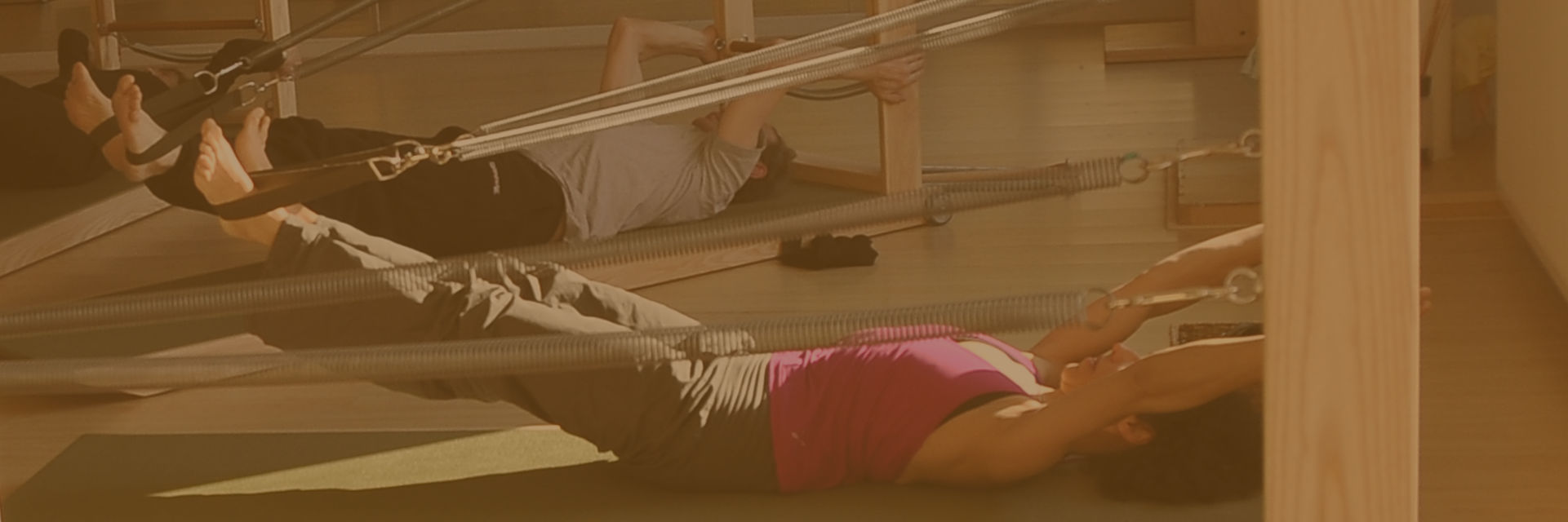
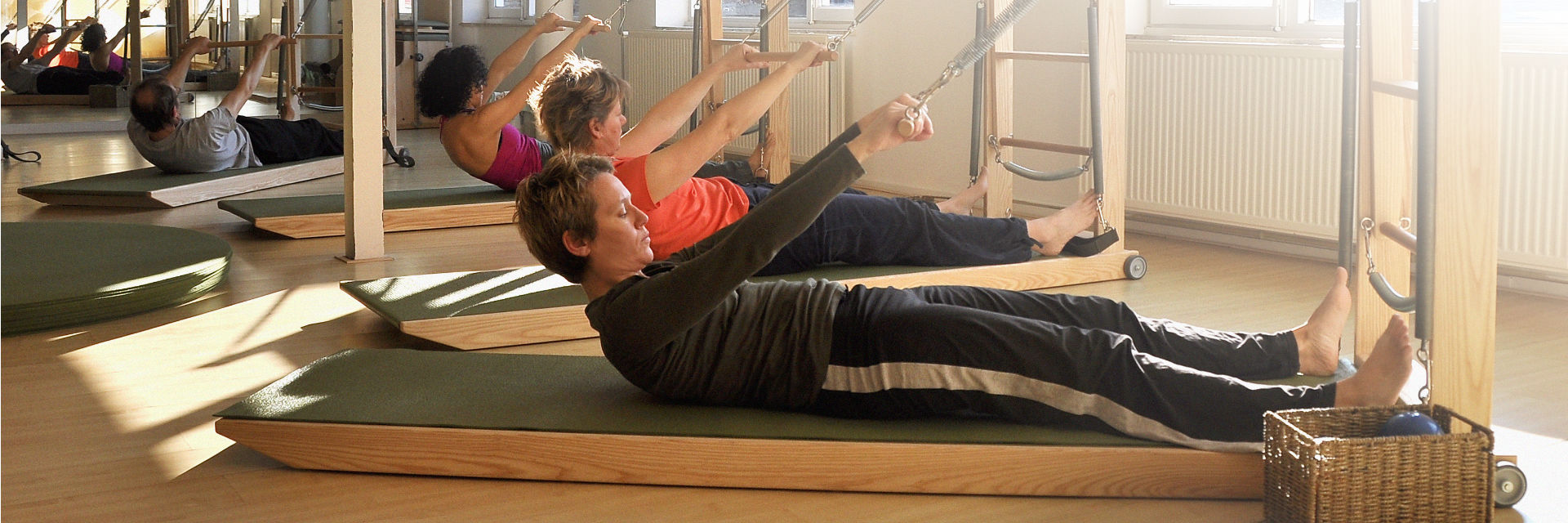
A movement done quickly, you do the way you always have. Slow it down, and you notice where it initiates and what else is going on along the way. That's why we work with the coil springs of the Spring Pilates Unit and the large stability ball. They give resistance and counter-pressure, and keep the exercise at a pace at which you can perceive what you're doing, for instance as you roll down vertebra by vertebra and roll back up again. Muscles, fascia and joints that are stiff are given time to start moving.
Your pelvic floor, the area down under
Your pelvic floor gets attention in every class, as part of the core. By core I mean more than the abdominals and buttocks. It begins under your feet and runs up through the inner legs, the pelvic floor, the psoas and the diaphragm, along the inside of the breastbone and the front of the spine, to around the hyoid and the temporal bones. The pelvic floor sits right in the middle of it. Together with your breath, it forms the strength from which a movement initiates. Then there's the anatomy: which layers there are, how you feel them and when you use them. Without that map, you're searching for a sensation without knowing quite where. Many people, for example, clench their buttocks the moment they think of their pelvic floor. You only notice that once you bring your attention there.
What you want is a pelvic floor that adapts to the task of the moment. It can work in two directions, contracting concentrically and lengthening eccentrically under tension. That's what you need for natural movements such as squatting and rising up again, running, jumping, laughing and sneezing.
Where in your pelvic floor is the tone too high, and where too low? Which muscles take over the work? What were you once taught to do with it? What did giving birth change? And how does it relate to the arches of your feet, your breath and the space around your throat?
The pelvic floor is often treated as a thing apart, best left well alone. In this class we talk about it, as a way in to feeling it during the exercises, because that's where the misunderstandings lie. At a slow pace you can perceive from within when you lengthen there and when you shorten, and whether that happens at the right moment.
How it differs from reformer Pilates
On a reformer you lie, sit or stand on a carriage that slides back and forth, and part of your attention goes into controlling that movement. On the Spring Pilates Unit your base is a stable, raised mat, and only the springs give with your movement. Your attention is then free to go to how the movement itself is built: where it initiates, and how it travels on from there through your body.
There is a reformer in the studio. I use it in personal training, one to one.
Everyone does the same exercise
At the start of class I ask how you are, and whether there's anything your body needs today. That shapes how I offer the exercises in that class. There are no levels: everyone does the same exercise, but how it looks varies from body to body and from day to day.
It's a lovely group. Aisha's jokes always make me laugh; she has a gift like no one else for finding the most fitting images for the exercises, which makes them work even better. It keeps me in balance, so that I can make my unstable back as strong as possible and keep it that way.
Practical
Small groups (max. 10 participants) · several classes a week (see the timetable) · trial class free · with a membership you can come to all group classes as often as you like