Myofascial Release
At ease in your body
You stretch, you massage, you move. And still the stiffness keeps coming back. One shoulder sits higher than the other. Your hip hurts when you put weight on it. Or you catch your reflection in a shop window and think: is that me?
Gravity pulls at you all day long, and the ground pushes back just as hard. When you stand in balance, that counter-pressure holds you upright. When you're out of plumb, your muscles have to do that work instead, and your body looks for a solution. Each solution calls for the next: a pelvis that drifts forward, an upper back that grows rounder, a head that reaches forward so you can still look ahead. And so a posture takes shape whose beginning you no longer remember.
Fascia is the connective tissue that surrounds, permeates and connects your organs, muscles and joints. Some parts are naturally tough, others soft and pliable. When you move, the layers glide over one another. Under the influence of poor working posture, stress, overload, old injuries or trauma, this tissue stiffens and the layers can stick together. The tissue then holds on to the posture your body has adopted.
Your natural alignment
Myofascial Release goes back to Ida Rolf's Structural Integration and Thomas Myers's Anatomy Trains. We bring the structure of your body and its fascial lines of tension into balance in relation to gravity.
Working together
I work while you lie, sit or stand, in the direction that matches your postural pattern. The treatment consists mainly of slow, sometimes deep strokes, in which I stretch and shift the fascia with my fingertips, knuckles, forearms or elbows. Meanwhile you make small movements yourself in the area we're working on, so that the fascial layers slide over one another and adhesions release.
Feeling what has changed
Once one side has been worked on, you get up and walk around. You now have two legs that aren't the same. That's the point: in the difference you feel what has changed and what it means for how you walk and stand. You learn simple exercises to repeat at home, so that the new relationships between your muscles and your fascia become part of how you move every day.
The series
Myofascial Release works over a series of sessions. Building the work up step by step sets change in motion in your posture, your movement and your energy, and you come to understand your body better.
Feet and legs, a foundation with spring
Your feet and legs carry you and determine your balance. If your arches or knees don't work well, or they hurt, that balance is disturbed. Stiffness in the ankles and at the back of the legs pushes the pelvis forward. The upper body leans back to stay upright, and the muscles of the lower back shorten. To keep your balance, the head reaches forward, so that the muscles of the upper back are overstretched and those of the neck shorten. To change a pattern like this, you start at the foundation.
This series works on the arches, ankles, calves and knees, and the front and back of the thighs, so that they carry your body better.
Around the pelvis
Your hips determine symmetry and balance. Shortened tissue in this area tilts the pelvis too far forward or back, which puts strain on the lower back. If the shortening is on one side, the pelvis is pulled sideways, or one hip rotates forward and the other back. That produces functional differences in leg length and rotations in the spine.
This series works on the inner thigh muscles, the muscles at the side of the pelvis, the deep gluteals and the psoas complex, so that this bridge between your legs and your spine finds its balance again.
A neck in balance
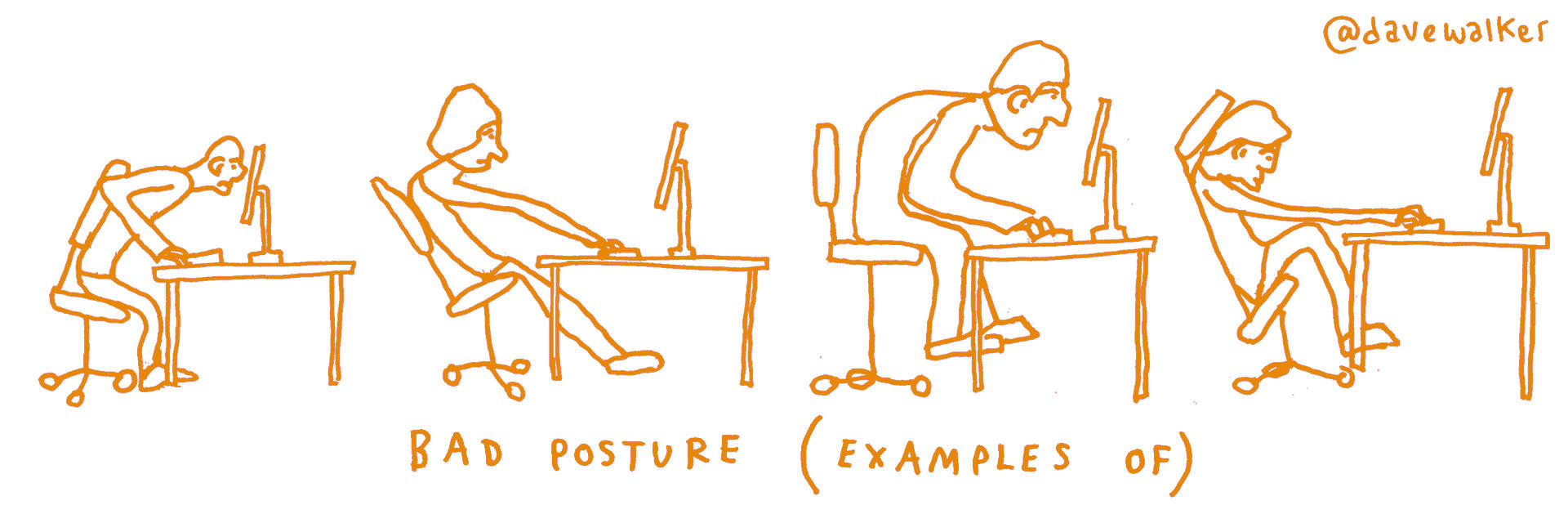
Pain in the neck and upper back is common, especially among people who sit for work. It arises because the head sits too far forward in relation to the shoulders, so that some muscles become short and stiff while others weaken and are overstretched.
The natural curve of your neck may change, nerves become irritated, and a burning, nagging pain develops in the neck and between the shoulder blades. People who take this to their doctor are often told the X-ray shows wear and tear, and that nothing can be done about it. About the wear itself, that's true. But wear and pain aren't the same thing: plenty of people with worn neck joints have no trouble at all. What hurts is pressure and strain on tissue that can't cope with it, and those relationships can be changed.
This series works on the large movement muscles, the respiratory muscles and the deep postural muscles of the neck and upper back.
Meet first, or start straight away
A first conversation is free and commits you to nothing. Together we look at what you'd like to achieve and what would suit you.
If you'd rather begin at once, you can book an introductory series of three sessions. It costs €195.