
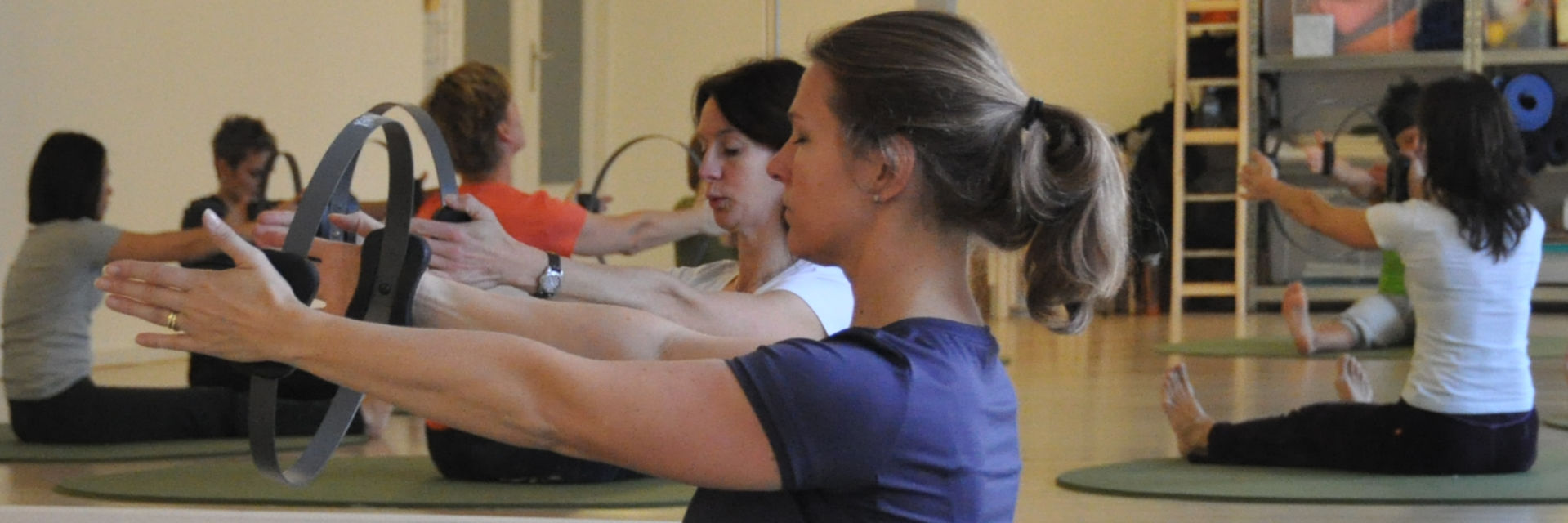
Love spring resistance, but baulk at the idea of a reformer group class?
Reformer classes have a reputation for being tough. Any class can be tough, a class on the tower included, but that isn't what I'm aiming for. At Spring Pilates in Maastricht I teach group classes on the Spring Pilates Unit, a piece of apparatus comparable to a Pilates tower. My aim is to give you the chance to learn to change your movement patterns, and the springs are a welcome help in that. The reformer I use in personal training. The difference between the classes lies less in the apparatus than in how a class unfolds.
Two kinds of class
A reformer class that follows a format has a tight structure, like a workout. Everyone does the same thing at the same pace and follows the teacher's instructions in unison, as in a ballet class. Music helps with that, and it can be enjoyable. Adjusting the reformer between sets is then part of the workout.
If you need more time, you keep the others waiting and feel awkward about it. Or you keep up, and that comes at the expense of your precision, your breathing, your alignment and, above all, of feeling how you do something.
For me, and for many others, it works differently. If I want to do something well, I have to understand how to do it and what I need to do differently from what I've always done. That means a slower pace and fewer repetitions. My brain needs time to take on a sequence or to change one. For me, Pilates is neuromuscular training.
What happens in my class
There's no music in my group classes. In some exercises I set the timing and the accents, and everyone follows them. If you 'do your own thing', the instruction no longer keeps pace with your movement and is of no use to you. At a tricky passage you're inclined to put your foot down, as you might at a transition, to get past it quickly. That's where I slow you down. This is how you learn to solve the problem, with better timing, coordination and a more nuanced use of your core.
In other exercises I keep no strict rhythm, and you find your own. Whoever's ready begins.
The Spring Pilates Unit has to be adjusted too. At first that takes a bit of working out. I'll help you with it, or an experienced participant next to you will, and you can watch what they do. Within ten classes you'll know how it goes.
The reformer and the Spring Pilates Unit
On a reformer you lie, sit or stand on a carriage that slides back and forth, and part of your attention goes into controlling that movement. The Spring Pilates Unit is comparable to a Pilates tower: a stable, raised mat with a tower behind it, a frame with springs and a push-through bar. Only the springs give with your movement. Your attention is free to go to how the movement itself is built, where it begins and how it carries on from there through your body.
Personal training on the reformer
My reformer is a combined reformer and tower. In personal training you get to know the classical repertoire at your own pace, or you extend it. You experience the reformer as a support for your body and an extension of it. The springs are extra muscles, which can give you other options for moving.
The apparatus is adjustable. If you have limitations somewhere, you can still practise, and the exercises are adapted to you. The time you spend on an exercise is tailored to your goal and what's possible for you. You can also use the reformer for exercises other than the Pilates classics. It's a remarkably versatile piece of equipment.
On the reformer you can jump with a jumpboard while lying on your back. With a single spring, for example, you jump slowly; I call it 'moonjumping'. It's slower than jumping upright. On the one hand, that gives you more time to land cleanly, to let the muscles of your feet spring, to bend your ankles and knees, and to feel your hamstrings, buttocks and pelvic floor lengthen. On the other hand, you're on your way for longer in the push-off phase. All that time your abdominal muscles are working against the weight of your extending, almost horizontal legs. So you feel, in the moment itself, both the relationship and the distinction between your abdominal muscles and your pelvic floor.
Taking it further
Would you like to try a group class on the Spring Pilates Unit? You can, in Essential Pilates, and the trial class is free. If you'd like to work on the reformer, you can do so in personal training on the Pilates Reformer. Getting to know each other is free.